Biography
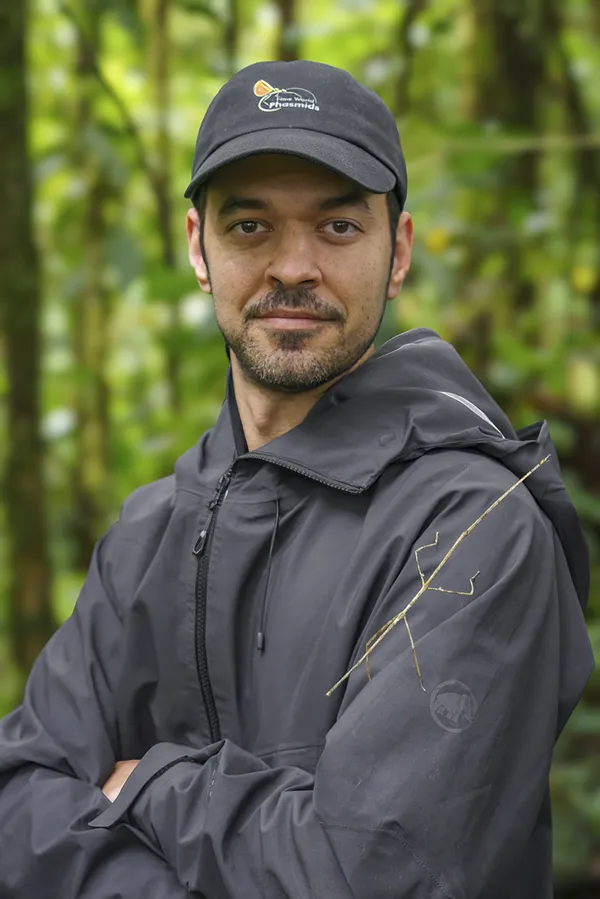
Pablo Valero Riquelme (Orihuela, Spain, 1986) is a professional entomologist who specialises in the study of phasmids (stick insects) from Europe and the Americas. From a very young age, he felt a deep fascination for nature and insects, which led him to study Biology at the University of Murcia (Spain), where he soon began to actively participate in entomological research projects.
Due to his track record and shortly before completing his studies, he was offered the opportunity to join a world-leading research team in Germany, comprising the leading specialists in New World Phasmatodea taxonomy, Oskar Conle and Frank Hennemann. Consequently, he assumed responsibility for the comprehensive management of a private laboratory and the conservation of scientific collections, the coordination and collaboration of international research projects, the planning and direction of scientific field expeditions, and the development of new research lines and scientific publications.
With over ten years of experience, he is currently a research associate at the Zoologische Staatssammlung München (Germany) and a collaborator in the Department of Zoology and Physical Anthropology at the University of Murcia (Spain). His work ranges from fieldwork to the laboratory, including molecular studies, although he has particularly focused on the taxonomy of phasmids. He has been involved in the description of several genera and numerous new species for science, with many more still awaiting publication.
Furthermore, he combines his scientific projects with his main hobby, nature photography. All the images displayed on this website are the result of his own photographic work in the field or laboratory. Through them, he aims to make science, and entomology in particular, more appealing to the general public, showcasing its fascinating beauty without sacrificing scientific rigour.
He is the founder of New World Phasmids (2025), a project whose main objective is to bring science closer to society, train new generations of naturalists and taxonomists, and raise awareness of both the importance of taxonomy and the threats that this discipline currently faces. Because without taxonomy, applied biology isn't possible: it's the basic language of biodiversity. Any action involving living beings – from conserving an ecosystem to curing a disease – needs to know, first and foremost, which organisms are involved.
Scientific Publications
- Valero, P. & Ortiz, A.S. (2015). Description and DNA barcoding of a new Iberian species of Pijnackeria (Scali, 2009) from Sierra Nevada, Spain (Phasmida: Diapheromeridae). Zootaxa, 4058 (4), 535–550. https://doi.org/10.11646/zootaxa.4058.4.5
- Cumming, R.T., Valero, P. & Teemsma, S.N. (2018). Description of Phyllium (Phyllium) conlei, new species, and a first look at the Phylliidae (Phasmatodea) of the Lesser Sunda Islands, Indonesia. Insecta Mundi, 0677, 1–9.
- Conle, O.V., Hennemann, F.H. & Valero, P. (2020). Studies on neotropical Phasmatodea XXII: Two new species of Taraxippus (Phasmatodea: Cladomorphinae: Hesperophasmatini) and the first record of the genus from Central America. Journal of Orthoptera Research 29(1): 101-114. https://doi.org/10.3897/jor.29.51328
- Conle, O.V., Hennemann, F.H., Bellanger, Y., Lelong, P., Jourdan, T. & Valero, P. (2020). Studies on neotropical Phasmatodea XX: A new genus and 16 new species from French Guiana. Zootaxa, 4814 (1), 1–136. https://doi.org/10.11646/zootaxa.4814.1.1
- Hennemann, F.H., Conle, O.V., Perez-Gelabert, D.E. & Valero, P. (2020). Estudios sobre Phasmatodea neotropicales XXI: Sigaruphasma, un nuevo género de Hesperophasmatini Bradley y Galil, 1977, de la Hispaniola, con la descripción de dos nuevas especies (Phasmatodea: Cladomorphinae). Novitates Caribaea, (16), 58–79. https://doi.org/10.33800/nc.vi16.227
- Hennemann, F.H., Conle, O.V. & Valero, P. (2021). Studies on Neotropical Phasmatodea XXIII: Bostriana n. gen., a new genus of Diapheromerinae from Bolivia (Phasmatodea: Occidophasmata: Diapheromeridae). Studies on Neotropical Fauna and Environment, 57(3), 273–282. https://doi.org/10.1080/01650521.2020.1867951
- Forni, G., Martelossi, J., Valero, P., Hennemann, F., Conle, O., Luchetti, A. & Mantovani, B. (2022). Macroevolutionary Analyses Provide New Evidence of Phasmid Wings Evolution as a Reversible Process. Systematic Biology, Volume 71, Issue 6, Pages 1471–1486. https://doi.org/10.1093/sysbio/syac038
- Hennemann, F.H., Conle, O.V., Valero, P. & Nishida, K. (2022). Studies on Neotropical Phasmatodea XXV: Revision of Pterinoxylus Serville, 1838, with the descriptions of two new species from Costa Rica. (Phasmatodea: Oriophasmata: Cladomorphinae: Pterinoxylini). Zootaxa, 5208 (1), 1–72. https://doi.org/10.11646/zootaxa.5208.1.1
- Ghirotto, V.M., Crispino, E.B., Engelking, P.W., Neves, P.A.B.A., Valero, P., Soares, T.F., Silva-Soares, T., Alves, T.J.D.S., Sisnando, P., Heleodoro, R.A., Conle, O.V., Hennemann, F.H. & Chiquetto-Machado, P.I. (2024). Thirteen new species of Urucumania (Phasmatodea: Pseudophasmatidae) stick insects from Brazil and Bolivia. Biologia, 79, 2707–2769. https://doi.org/10.1007/s11756-024-01699-1
- Ghirotto, V.M., Conle, O., Hennemann, F., Valero, P. & Cancello, E.M. (2024) On the Brazilian Exocnophila stick insects (Insecta: Phasmatodea), with the description of a new species. Zootaxa, 5536 (1), 59–98. https://doi.org/10.11646/zootaxa.5536.1.2
- Conle, O.V., Valero, P. & Hennemann, F.H. (2024). A new Trychopeplus species (Phasmatodea, Diapheromerinae, Cladomorformia) discovered from Ecuador’s enigmatic Chocó ecoregion. Zookeys, 1217: 309-326. https://doi.org/10.3897/zookeys.1217.130397
- Conle, O. V., Hennemann, F. H., Valero, P., Schwarz, C. J., Engelking, P. W., Neves, P. A. B. A., Chiquetto-Machado, P. I., & Ghirotto, V. M. (2025). Studies on Neotropical Phasmatodea XXVII: a new endemic stick insect genus with two species from the Atlantic Forest of Brazil (Phasmatodea: Pseudophasmatidae: Pseudophasmatinae: Pseudophasmatini). Papéis Avulsos De Zoologia, 65, e202565036. https://doi.org/10.11606/1807-0205/2025.65.036